

Preparing for a final exam in chemistry demands a strategic approach, utilizing focused study guides to accelerate learning and solidify foundational concepts.
A. The Importance of a Study Guide
A well-crafted study guide is paramount for success in any chemistry exam, especially a comprehensive final. It’s more than just a collection of notes; it’s a personalized learning tool. Effective guides distill complex information into manageable segments, highlighting key concepts, formulas, and problem-solving techniques.
They facilitate active recall, forcing you to engage with the material rather than passively rereading it. This process strengthens memory and understanding. A study guide also allows for targeted review, pinpointing areas where you need further practice.
Furthermore, creating a guide itself is a valuable study method. The act of organizing and summarizing information reinforces learning. Remember, chemistry builds upon itself, so a solid foundation is crucial. A focused guide ensures you don’t overlook essential principles when preparing for your final exam.
B. Understanding the Scope of General Chemistry
General Chemistry encompasses a broad range of fundamental principles, making a clear understanding of its scope vital for final exam preparation. Typically, it begins with atomic structure and periodic trends, progressing to chemical bonding and molecular geometry. Mastering stoichiometry and chemical calculations is also essential, forming the basis for quantitative problem-solving.
Beyond these foundations, expect coverage of states of matter, gas laws, and the properties of solutions. Chemical kinetics and equilibrium are crucial for understanding reaction rates and the extent of reactions. A comprehensive final will likely integrate these concepts, requiring you to apply them in diverse scenarios.
Therefore, your study guide should reflect this breadth, ensuring you’ve reviewed all major topics. Prioritize understanding the connections between these areas, as chemistry is rarely isolated to a single concept.

II. Foundational Concepts to Master
Success in general chemistry hinges on a firm grasp of core principles; diligent review of atomic structure, bonding, and stoichiometry is paramount for exams.
A. Atomic Structure and Periodic Trends
A comprehensive understanding of atomic structure forms the bedrock of chemistry. Begin by revisiting the components of an atom – protons, neutrons, and electrons – and their respective roles in determining an element’s properties. Thoroughly review electron configurations and how they relate to an element’s position on the periodic table.
Mastering periodic trends is crucial. Understand how electronegativity, ionization energy, atomic radius, and metallic character vary across periods and down groups. Practice predicting these trends and explaining the underlying reasons for them. Be prepared to apply this knowledge to compare and contrast the properties of different elements.
Don’t overlook the significance of isotopes and average atomic mass calculations. Practice problems involving these concepts will solidify your understanding. Finally, remember that a strong foundation in atomic structure and periodic trends will simplify more complex chemistry topics later on, making exam preparation significantly easier.
B. Chemical Bonding and Molecular Geometry
Delve into the different types of chemical bonds – ionic, covalent, and metallic – understanding how electron sharing or transfer dictates their formation. Focus on Lewis structures; practice drawing them accurately to represent bonding in various molecules and polyatomic ions. Mastering formal charge calculations is essential for determining the most stable Lewis structure.
Next, explore Molecular Geometry using VSEPR theory. Predict the shapes of molecules based on the number of electron groups around the central atom. Understand how lone pairs influence bond angles and overall molecular shape. Be able to identify polar and nonpolar bonds and molecules, relating this to electronegativity differences.

Finally, connect molecular geometry to intermolecular forces (dipole-dipole, London dispersion, hydrogen bonding). These forces significantly impact physical properties like boiling point and solubility. Practice predicting these properties based on molecular structure and bonding.
C. Stoichiometry and Chemical Calculations
Stoichiometry is the cornerstone of quantitative chemistry. Master balancing chemical equations, ensuring the law of conservation of mass is upheld. Practice converting between moles, mass, and number of particles using Avogadro’s number and molar mass. Understand the concept of limiting reactants and excess reactants in chemical reactions – crucial for calculating theoretical yield.
Focus on percentage yield calculations, accounting for experimental errors and losses during reactions. Dilution problems are also common; practice using the formula M1V1 = M2V2 to determine concentrations after dilution. Be proficient in calculating empirical and molecular formulas from experimental data.
Finally, tackle gas law stoichiometry, combining the ideal gas law (PV=nRT) with stoichiometric ratios to solve for volumes, pressures, and amounts of gaseous reactants and products.
III. Key Chemistry Topics for Exam Preparation
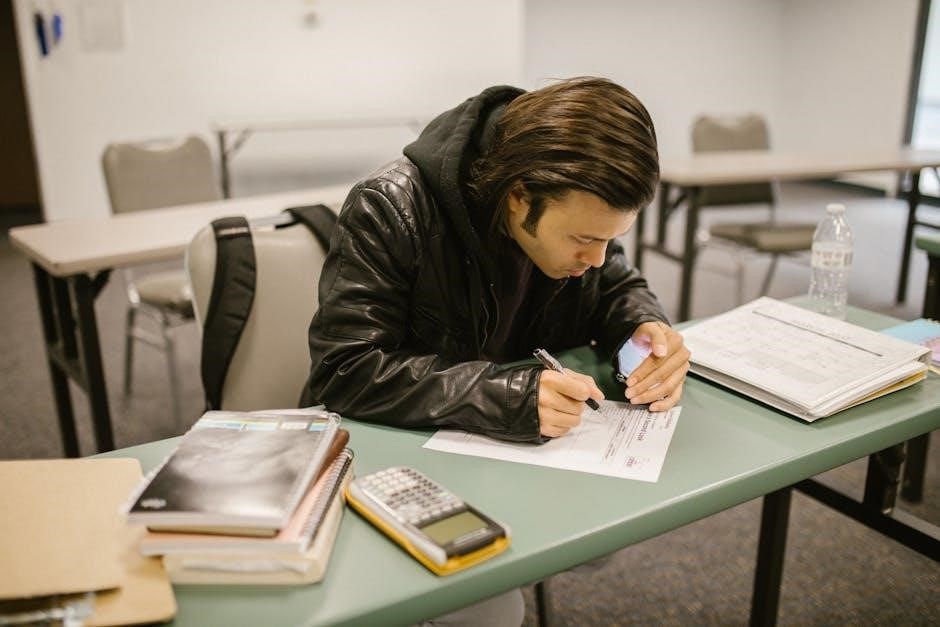
Exam success hinges on mastering core topics: states of matter, solutions, kinetics, and equilibrium – essential for predicting chemical behavior and reaction outcomes.
A. States of Matter and Gas Laws
Understanding the behavior of matter in its various states – solid, liquid, and gas – is fundamental. Focus on intermolecular forces and how they dictate physical properties. Thoroughly review the Gas Laws: Boyle’s, Charles’s, Gay-Lussac’s, and Avogadro’s. Be prepared to apply the Ideal Gas Law (PV=nRT) and understand its limitations.
Practice calculations involving gas density, molar mass determination, and stoichiometry of gaseous reactions. Don’t overlook Dalton’s Law of Partial Pressures and Graham’s Law of Effusion. Mastering these concepts requires not just memorization, but a conceptual grasp of how pressure, volume, temperature, and the number of moles relate to each other.
Real gas behavior and deviations from ideality, often due to intermolecular attractions and molecular volume, should also be considered. Work through numerous practice problems to build confidence and ensure you can apply these laws effectively in various scenarios presented on the exam.
B. Solutions and Colligative Properties
A strong understanding of solutions is crucial. Define key terms like solute, solvent, concentration (molarity, molality, percent composition), and solubility. Practice dilution calculations and understand the factors affecting solubility – temperature, pressure (for gases), and polarity.
Colligative properties – boiling point elevation, freezing point depression, osmotic pressure, and vapor pressure lowering – are essential. Memorize the relevant formulas and understand why these properties change with the addition of a solute. Focus on applying these concepts to real-world scenarios.
Pay attention to electrolyte solutions and the van’t Hoff factor. Be prepared to calculate colligative properties for both nonelectrolytes and electrolytes. Practice problems involving determining molar masses from colligative property measurements are common exam features. Conceptual understanding is key to success in this area.
C. Chemical Kinetics and Equilibrium
Chemical kinetics explores reaction rates and factors influencing them – concentration, temperature, catalysts, and surface area. Master the rate law determination, including methods like the initial rates method and integrated rate laws (zero, first, and second order). Understand the concept of activation energy and its relationship to the rate constant via the Arrhenius equation.
Chemical equilibrium is equally vital. Grasp Le Chatelier’s principle and its application to predict how changes in conditions (concentration, temperature, pressure) shift equilibrium. Practice calculating equilibrium constants (Kc and Kp) and using ICE tables to determine equilibrium concentrations.

Be prepared to solve problems involving reaction quotients (Q) and their comparison to K to determine the direction a reaction will shift. Understand the relationship between Kc and Kp, and practice applying these concepts to various reversible reactions.

IV. Effective Study Techniques
Maximize learning through active recall, spaced repetition, and consistent practice problems; flashcards and mnemonics further enhance memory retention for the chemistry exam.
A. Active Recall and Spaced Repetition
Active recall, a powerful learning technique, involves actively retrieving information from memory rather than passively rereading notes. This strengthens neural pathways, improving long-term retention – crucial for a chemistry final exam. Regularly test yourself with practice questions, flashcards, or by attempting to explain concepts aloud without looking at your materials.
Spaced repetition complements active recall by strategically reviewing material at increasing intervals. Instead of cramming, revisit topics shortly after learning them, then again after a day, a week, and so on. This combats the forgetting curve and solidifies understanding. Utilize spaced repetition software or create your own review schedule.
Combining these techniques – actively trying to remember, then revisiting at optimal times – dramatically boosts exam performance. Self-testing at the end of each study session, as suggested by experts, reinforces learning and identifies areas needing further attention. Consistent application of active recall and spaced repetition will transform your study habits and lead to greater success on your chemistry final.


B. Practice Problems and Exam Simulations
Consistent practice with a wide range of chemistry problems is paramount for final exam success. Don’t just memorize formulas; apply them! Work through textbook examples, assigned homework, and seek out additional problem sets online or from study guides. Focus on understanding the process of solving problems, not just arriving at the correct answer.
Exam simulations are invaluable. Taking full-length practice exams under timed conditions replicates the actual exam environment, building both content mastery and test-taking stamina. Analyze your performance on these simulations, identifying weak areas and recurring errors.
Prioritize problems mirroring the types expected on your final – multiple choice, calculations, and conceptual questions. The “6 Steps Chem Learning Method” emphasizes thoroughly working through problems. Regularly testing yourself, as recommended, reinforces concepts. This focused practice builds confidence and prepares you to tackle any challenge on exam day.
C. Utilizing Flashcards and Mnemonics
Flashcards are a powerful tool for memorizing key terms, definitions, polyatomic ions, and reaction patterns in chemistry. Create flashcards for concepts you find challenging, and review them frequently using spaced repetition – revisiting cards at increasing intervals. This technique strengthens long-term retention.
Mnemonics – memory aids like acronyms, rhymes, or visual associations – can help you recall complex information. For example, create a sentence to remember the order of elements in a group or a catchy phrase to recall a specific rule.
Don’t underestimate the power of visual learning. Diagrams and mind maps can help you connect concepts and see the bigger picture. Combine flashcards and mnemonics with active recall and practice problems for a comprehensive study approach. Remember, consistent effort is key to mastering chemistry!
V. Exam-Specific Strategies
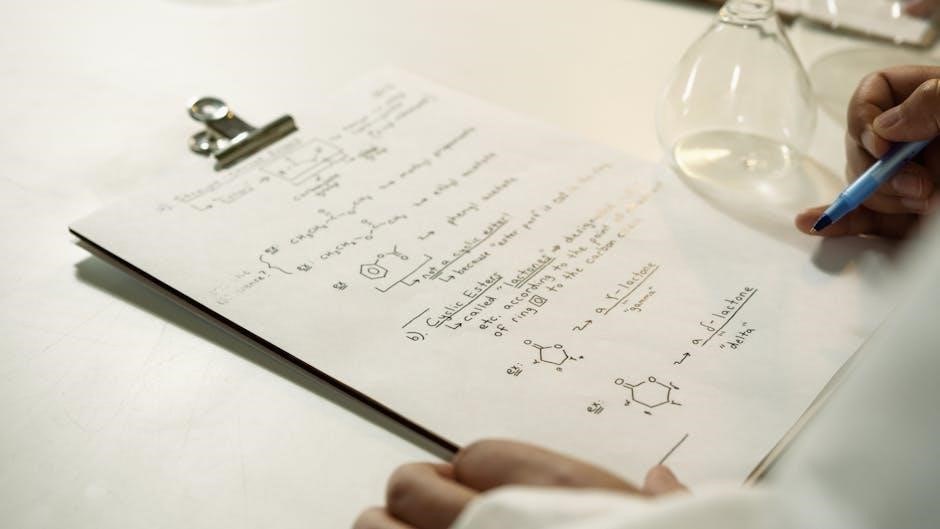
Success on your final exam hinges on effective time management, careful question analysis, and avoiding common pitfalls during the testing process itself.
A. Time Management During the Exam
Effective time allocation is paramount during a chemistry final exam. Begin by quickly surveying the entire exam to gauge its length and the point value assigned to each question. This initial assessment allows you to prioritize, tackling easier, higher-point questions first to secure those marks.
Allocate a specific time budget for each question, and strictly adhere to it. If you find yourself stuck on a problem, don’t dwell excessively; make a note to revisit it later if time permits. Resist the temptation to spend too long on any single question, potentially sacrificing points on others you could easily answer.
Bring a watch to monitor your progress, and periodically check the remaining time. Don’t forget to reserve a few minutes at the end for a final review, ensuring you’ve answered all questions and haven’t made any careless errors. Prioritization and disciplined pacing are key to maximizing your score.
B. Analyzing Question Types (Multiple Choice, Problem Solving)
A chemistry final exam typically features diverse question types, demanding tailored strategies. Multiple-choice questions often test conceptual understanding; carefully read each option, eliminating obviously incorrect answers first. Look for keywords and qualifiers that differentiate choices. Don’t hesitate to make educated guesses if unsure, as there’s usually no penalty for incorrect attempts.
Problem-solving questions require a systematic approach. Begin by identifying the knowns and unknowns, then select the appropriate formula or equation. Show all your work clearly, as partial credit is often awarded. Pay close attention to units and significant figures.
Practice recognizing common problem types and the strategies needed to solve them. Understanding the underlying principles is crucial for tackling unfamiliar variations. Mastering both conceptual recall and quantitative skills is essential for success.
C. Common Mistakes to Avoid
During a chemistry final exam, several common pitfalls can hinder performance. Unit conversions are frequently mishandled; always include units and ensure they cancel correctly. Significant figures are often overlooked – adhere to the rules for calculations and final answers. Incorrect formula selection is another frequent error; double-check the appropriate equation for each problem.
Conceptual misunderstandings can lead to systematic errors. Ensure a firm grasp of core principles before attempting calculations. Careless arithmetic errors are easily made; take your time and double-check each step. Ignoring instructions, such as specifying units or showing work, can result in lost points.
Finally, panicking can derail your focus. Practice under timed conditions to build confidence and manage exam anxiety. Review past mistakes to avoid repeating them.

VI. Resources for Chemistry Exam Study
Numerous resources can bolster your preparation for a chemistry final exam. Textbooks and course notes remain fundamental, providing a comprehensive overview of covered material. Online platforms like Khan Academy and Chem LibreTexts offer free video tutorials and practice exercises. University tutoring centers provide personalized assistance and clarification of difficult concepts.
Practice exams, often available from professors or online, simulate the exam environment and identify areas for improvement. Flashcard apps, such as Quizlet, facilitate memorization of key terms and definitions. Chemistry-specific websites offer problem-solving strategies and detailed explanations.
Don’t underestimate the value of study groups for collaborative learning and peer support. Utilize periodic tables and formula sheets during practice, but understand the underlying principles.